Weight-lifting record
Pioneering Spirit is the world’s largest work vessel and the first that can remove oil platform topsides in a single lift. It could speed up North Sea decommissioning, reports Lydia Heida.
“It has been a very long road to get this far,” says Edward Heerema, president and founder of Allseas, who has dedicated nearly 30 years to the development of the giant work vessel Pioneering Spirit. “I’m a fanatical engineer, so it has given a lot of pleasure, but many worries as well.”
Heerema developed the idea for Pioneering Spirit as long ago as 1987, but commissioning took place three decades later, in 2007. The vessel was built in South Korea by Daewoo and arrived in Rotterdam, the largest port in the Netherlands, for final outfitting in January 2015.
In August 2016, Pioneering Spirit completed its first commercial project, removing the 13,500-tonne Yme oil platform topside for Repsol in the Norwegian North Sea. With its double bow, the vessel can straddle a platform and lift a topside with eight sets of lifting beams.
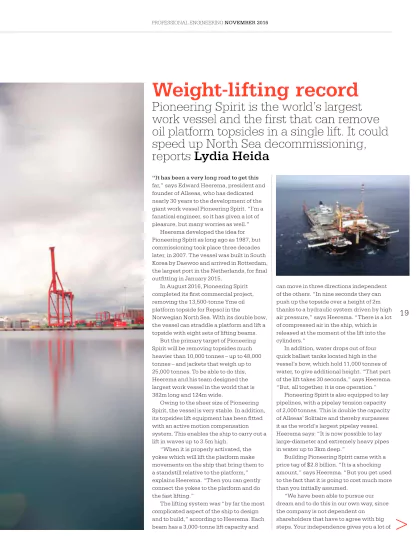
World’s largest work vessel
But the primary target of Pioneering Spirit will be removing topsides much heavier than 10,000 tonnes – up to 48,000 tonnes – and jackets that weigh up to 25,000 tonnes.
To be able to do this, Heerema and his team designed the largest work vessel in the world that is 382m long and 124m wide. Owing to the sheer size of Pioneering Spirit, the vessel is very stable.
In addition, its topsides lift equipment has been fitted with an active motion compensation system.
This enables the ship to carry out a lift in waves up to 3.5m high. “When it is properly activated, the yokes which will lift the platform make movements on the ship that bring them to a standstill relative to the platform,” explains Heerema. “Then you can gently connect the yokes to the platform and do the fast lifting.”
The lifting system was “by far the most complicated aspect of the ship to design and to build,” according to Heerema. Each beam has a 3,000-tonne lift capacity and can move in three directions independent of the others. “In nine seconds they can push up the topside over a height of 2m thanks to a hydraulic system driven by high air pressure,” says Heerema. “There is a lot of compressed air in the ship, which is released at the moment of the lift into the cylinders.”
Shocking amount
In addition, water drops out of four quick ballast tanks located high in the vessel’s bow, which hold 11,000 tonnes of water, to give additional height. “That part of the lift takes 30 seconds,” says Heerema. “But, all together, it is one operation.”
Pioneering Spirit is also equipped to lay pipelines, with a pipelay tension capacity of 2,000 tonnes. This is double the capacity of Allseas’ Solitaire and thereby surpasses it as the world’s largest pipelay vessel. Heerema says: “It is now possible to lay large-diameter and extremely heavy pipes in water up to 3km deep.”
Building Pioneering Spirit came with a price tag of $2.8 billion. “It is a shocking amount,” says Heerema. “But you get used to the fact that it is going to cost much more than you initially assumed. “We have been able to pursue our dream and to do this in our own way, since the company is not dependent on shareholders that have to agree with big steps. Your independence gives you a lot of possibilities, but you always have difficulty finding money.”
Building the vessel was delayed by six years because of the technical complexity of the lifting system and the banking crisis that started in 2008.
Complex challenges
“Suddenly banks could not lend us enough money to start building, so we had to wait until the banking crisis was over,” says Heerema.
Around 1,000 companies worldwide delivered significant parts for the ship, of which 50 are in the UK. Allseas drew up the conceptual design of Pioneering Spirit in-house, and UK-based Swan Hunter assisted in the basic design of the novel twin bows and the lifting systems. Swan Hunter’s staff spent 160,000 hours working on these designs.
Gerard Kroese, managing director of Swan Hunter, comments: “Many aspects of the design had never been seen on such a scale before. The engineers had to overcome lots of challenges that involved the complex systems contained within the vessel and the sheer size and loadings that come with such a concept.” In 2009, Deltamarin Finland produced the complete detail design of Pioneering Spirit. (...)
Publication: Professional Engineering Magazine
Date: November 2016
Would you like to read the entire article?
VIEW FULL STORYInterested in working together?
I'd love to hear from you.